Protected: Standing in a dark(room): A conversation with Louis Stopforth
For a generation of photographers, the darkroom will always have an aura of mysticism. A place of introspection, concentration and most importantly, of alchemy and surprise. It was there, amidst the amber lights and the smell of chemicals that the craft of photography was taught and practiced. A place away from time, oblivious to the world outside.
For this same generation and the enthusiastic few who followed, photographic processes were only taught through hands-on experimentation and practice. Like many processes based on chemical reactions, mastering these dark(room) arts depended on the teacher’s experience; many photographers priding themselves on having spent time in the dark with renowned masters.
In 2022 artist Louis Stopforth received the news that his photography teacher and mentor John Stadnicki had passed away. An esteemed photographer and much loved teacher, Stadnicki had personally opened the darkroom at South Gloucestershire & Stroud College (SGS) and was personally responsible for instilling a passion for photography in Stopforth as well as hundreds of his students over the three decades or so he headed the Photography programme.
Rushing down to the darkroom, Stopforth sought to capture the spirit of his mentor, and shot roll after roll of film, focusing on details which would be meaningful not just to analogue photographers, but especially to the generations of students who studied under Stadnicki’s tutelage in the darkroom which bore his name.
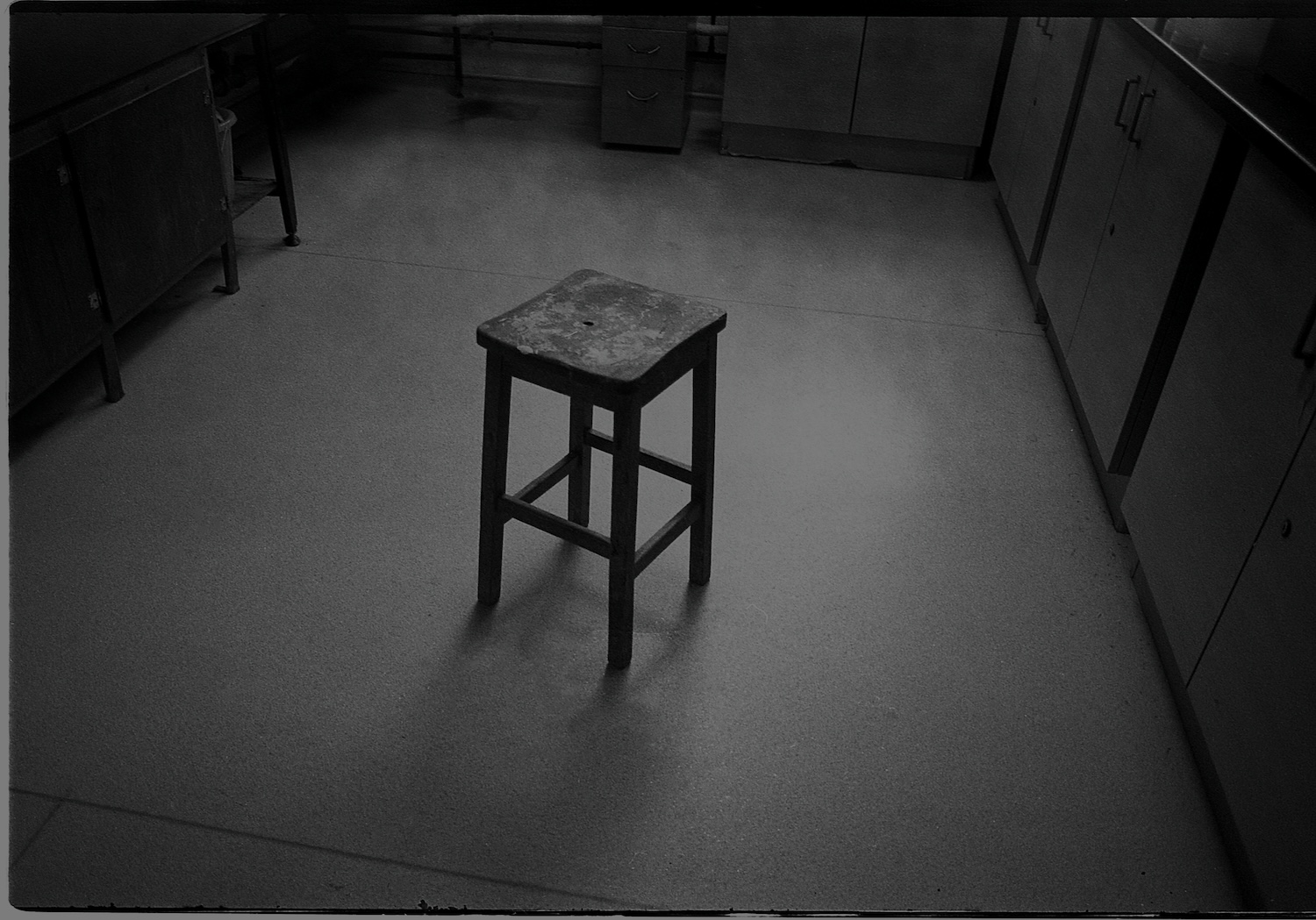
Out of the different images in the series Echoes in Light – In memory of John Stadnicki – a few especially resonate with me. A teacup sitting by a measuring beaker. Enlarger timers and films, and then there is a very poetic moment, a sort of silence. An empty stool in the middle of the room.
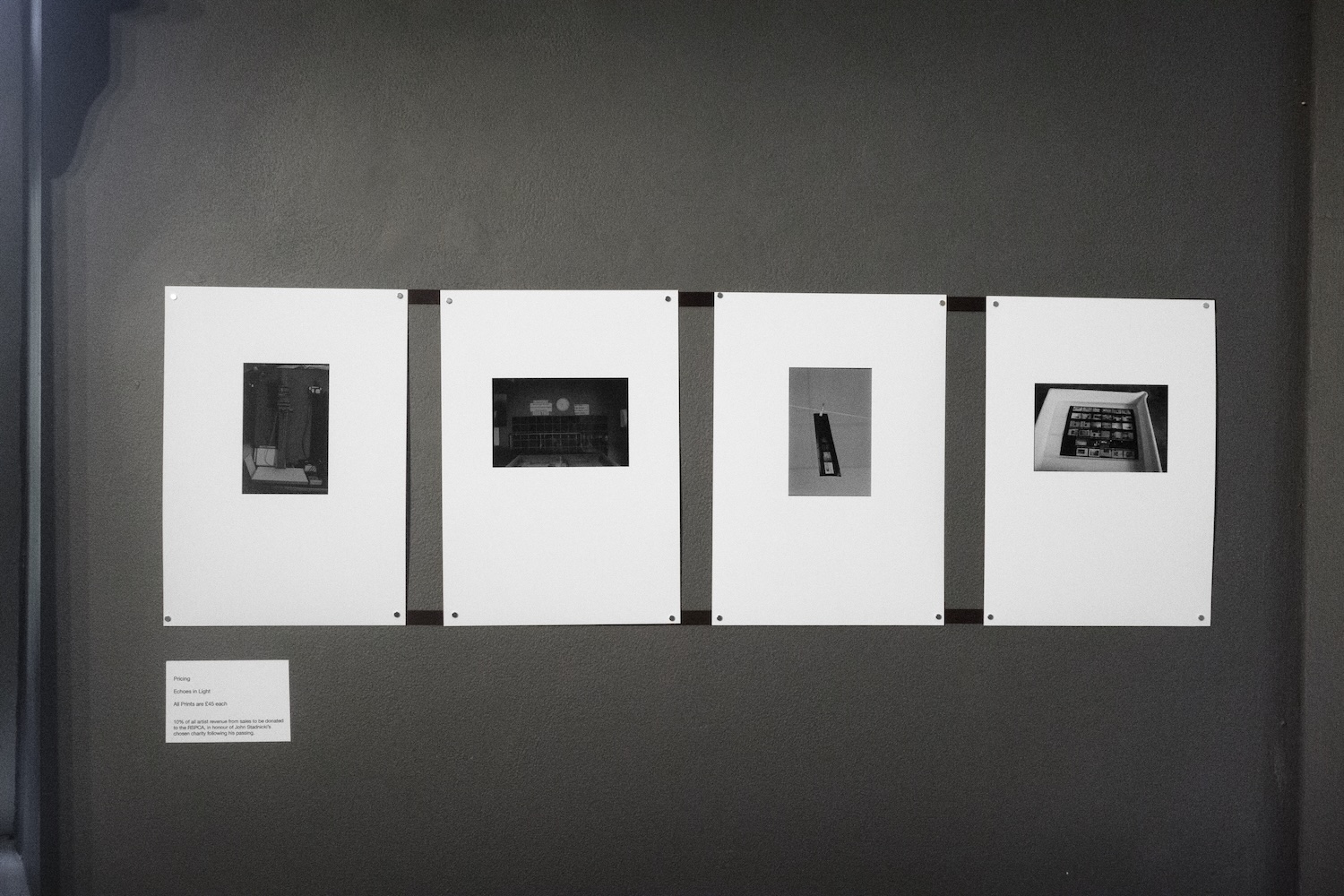


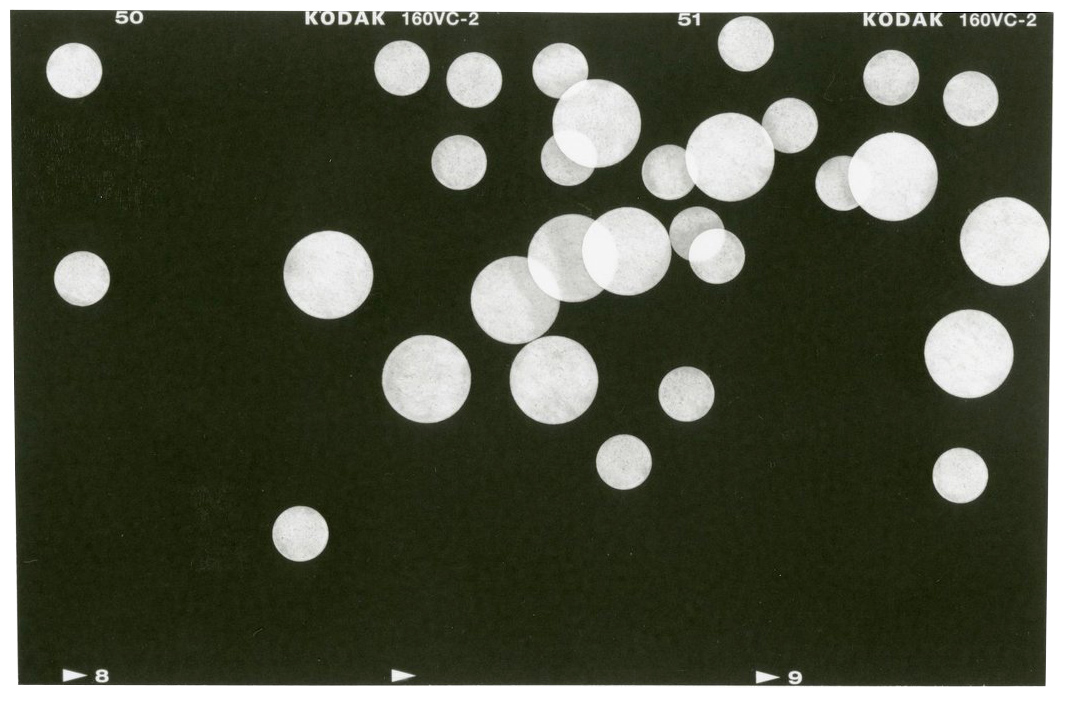
I am always in awe of artists who manage to talk about loss and mourning through their work. Their capacity to give shape to such abstract feelings. Talking with Stopforth about his project, he explained why it was so important to shoot a series of images to mark Stadnicki’s passing. Not only was he instrumental in Stopforth’s formative years, but he also helped him develop his final major project at college, exploring notions of memory and absence:
“Truthfully it’s quite hard to hard to answer that one. I think more than anything it was him as a person and the depth of character he had. John was a die-hard punk and really said what he thought. He had this sort of brutality to him, but on the contrary was extremely compassionate towards those within his immediate life as well as society at large. But his love for photography and the way he inspired so many to live their life to the absolute limit with the agency the medium affords you was simply unparalleled. He saw things in students that not even they had seen in themselves yet. I think in many ways what I remember the most is what I didn’t know at the time, but rather what I can see in hindsight – that this figure completely changed my life with a few rolls of film, cameras given to me from his collection, and the gruff way he circled the frames on my first contact sheets from his stool.
It’s interesting with photography and death being so intimately entangled through Roland Barthes, Susan Sontag, and so many works and images relating to death and yet even after producing this body of work I didn’t do it thinking about this sort of photo-history/highly cerebral element. At the time it really was about being back in that darkroom space in real time, and albeit whilst attempting to preserve the remnants of a person’s character in the darkroom, so much of it was about the experience and process of mourning.
There was a compulsion to be back in that specific space, thinking about John, his importance to myself and so many others, and producing a body of work in situ. Echoes in Light is really about processing – processing grief, and processing film and prints (whilst the time frame didn’t allow for it, I still managed to produce a small number of workprints from the project in the darkroom – some of the contact sheets and test strips appear in the images later exhibited).
We retook the conversation a few months later, this time in writing, coming back to the idea of photography and its connection to loss and mourning. I had mentioned Sophie Calle’s work, and I kept on thinking about trying to use the photographic medium to hold on to someone, or anything, a space or a feeling. Stopforth responded with a key insight, thinking about his position within the work:
I often felt like academia approaching death and photography do so from an observer’s position i.e Barthes looking at an image of his mother, Sontag looking at images of people killed in warzones, or Warhol working with images of deceased car crash victims for Death and Disaster.
Either the viewer is longing to return to the person or moment recorded, or they do so from a place of emotional distance to those deceased. And that’s very different, there is a point of removal. Echoes in Light was not about being an observer in this way, it was all about being within the processing mind. Whilst my desire to make the work refer to photography through documenting the processing of the films and contact sheets, it was also self-referential, capturing myself in the process. Whilst nothing is so flagrant as to be self-portraiture, my actions are, to a degree, recorded. There is one frame that includes my hand whilst developing film in the tank but I opted not to use it. I wanted to make a project that could be interpreted by any one of the thousands of students that John has taught. My hope was that it would trigger some form of memory in them…perhaps there is a nod to the Sontags and the Barthes of the world.
I was fortunate that some of the feedback I had on the work was from other students of John’s who said things along the lines of it instantly transported them back to their time there, the smell of the developer and John’s voice. I wanted to make this project for myself as a tool to process, as a way to honour John in the way that I think he would have wanted, but also as a way to facilitate a memory for those that studied under him.
The series was shown at CSS
It was the first real project I made working with photography and it was centred around my grandfather’s workshop. A master carpenter and joiner by trade but very much a fine artist at heart my grandfather’s space is dense with a lifetime’s worth of work. It’s littered with tools, and different types of wood, but it’s also a space with drawings pinned to the walls, sculptures made from materials gathered from jobsites, and quotes by great minds scrawled on the walls. It’s the first creative space I think I ever entered and the only one which has been consistent throughout my life. In a sense I think John’s darkroom resonated with me in the same way from the first days spent there over a decade ago; a space of creative chaos and one that bears the impression of a specific person. John and I would have long conversations about the physical marks we leave in time, and the complicated relationship between presence and absence. Fundamentally I think John was able to recognise something in my relationship to my grandfather’s workshop and what I was experiencing within the darkroom, and he was able to help me channel that into a project where the subject matter and workflow were cohesive to one another. Sadly this is ultimately something that would resurface again in the months following John’s passing.
After graduating from SGS, Stopforth was invited to join as a lecturer and Stadnicki became his colleague, teaching together in the same darkroom where Stopforth had been a student. Following Stadnicki’s death in 2024 he received further distressing news that the darkroom was to be closed and relocated as part of the college’s facilities maintenance plan.
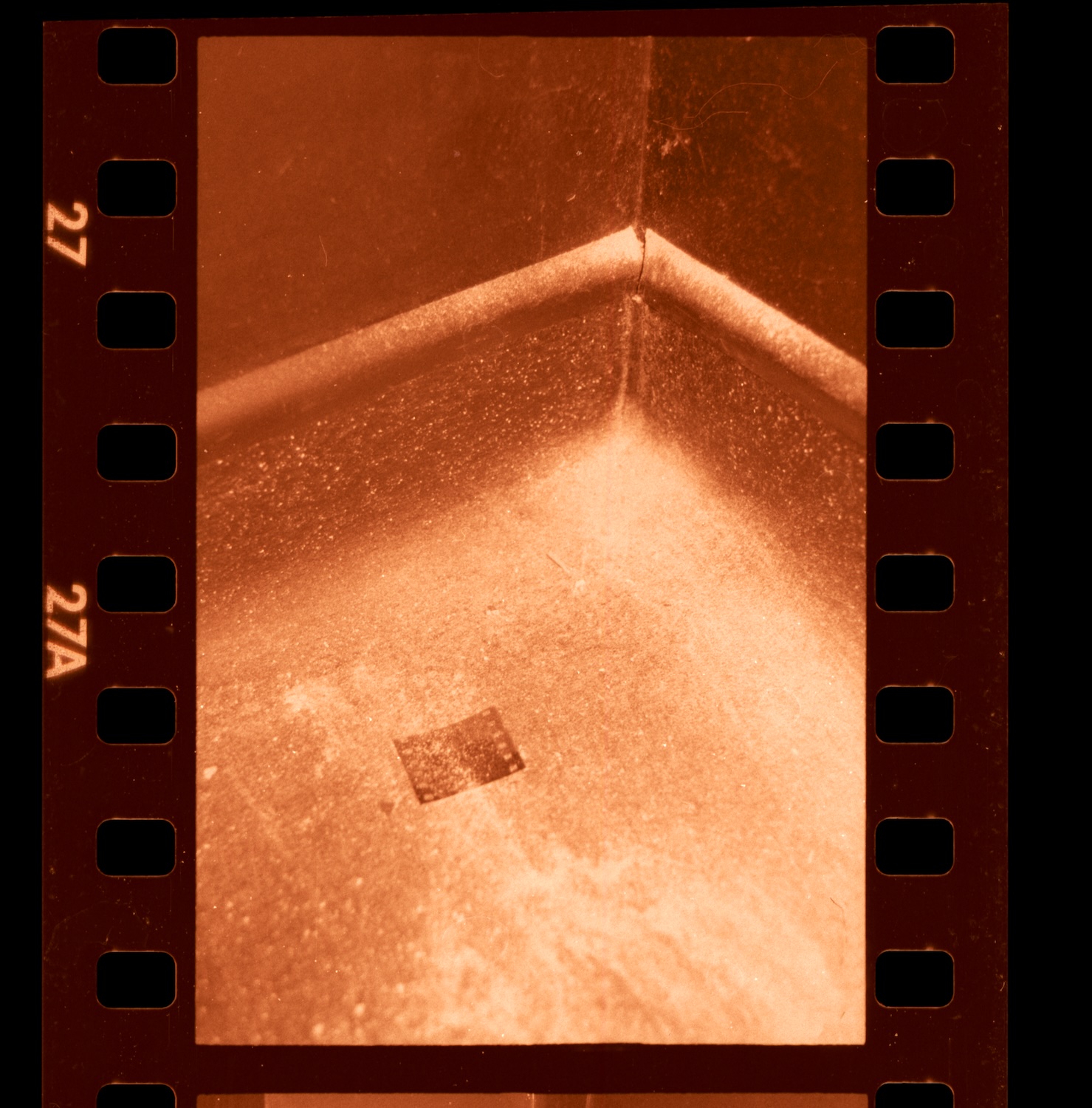
This second closure, not of a life but of a space so full of memories, led Stopforth to shoot a second series of images, entitled “In A Dark Room.” On this instance it wasn’t only the space of the darkroom, but the traces the analogue process leaves behind, which inspired Stopforth to experiment with the dust and debris left behind by the renovations as well as rust gathered from the original darkroom sinks. Using the colours and nature of rust, Stopforth turns the photographic film and prints into material evidence of the passage of time. The marks left on the darkroom’s walls and floors become the testament of the hundreds of student photographers who developed and printed their work there.
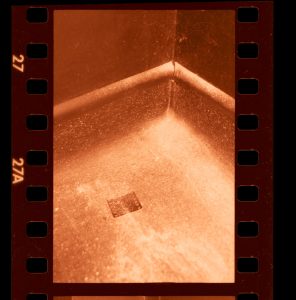
Perhaps this homage to Stadnicki also honours the generation of photographers and educators who, like me, learnt and taught the craft of photography in the darkroom. Here we see its not the architecture of the space which matters, but its use. This is the legacy in need of urgent preservation. We can have one last look at Stadnicki’s original darkroom setup. This inevitably makes me think of the closure of so many photography darkrooms across the world. “In A Dark Room” is a methodical study of a space that is no longer relevant or feasible for its increasingly impracticable purpose.
I asked Stopforth what was it from the time with Stadnicki that he remembered the most:
“Truthfully it’s quite hard to hard to answer that one. I think more than anything it was him as a person and the depth of character he had. John was a die-hard punk and really said what he thought. He had this sort of brutality to him, but on the contrary was extremely compassionate towards those within his immediate life as well as society at large. But his love for photography and the way he inspired so many to live their life to the absolute limit with the agency the medium affords you was simply unparalleled. He saw things in students that not even they had seen in themselves yet. I think in many ways what I remember the most is what I didn’t know at the time, but rather what I can see in hindsight – that this figure completely changed my life with a few rolls of film, cameras given to me from his collection, and the gruff way he circled the frames on my first contact sheets from his stool.
It’s interesting with photography and death being so intimately entangled through Roland Barthes, Susan Sontag, and so many works and images relating to death and yet even after producing this body of work I didn’t do it thinking about this sort of photo-history/highly cerebral element. At the time it really was about being back in that darkroom space in real time, and albeit whilst attempting to preserve the remnants of a person’s character in the darkroom, so much of it was about the experience and process of mourning.
There was a compulsion to be back in that specific space, thinking about John, his importance to myself and so many others, and producing a body of work in situ. Echoes in Light is really about processing – processing grief, and processing film and prints (whilst the time frame didn’t allow for it, I still managed to produce a small number of workprints from the project in the darkroom – some of the contact sheets and test strips appear in the images later exhibited).
We retook the conversation a few months later, this time in writing, coming back to the idea of photography and its connection to loss and mourning. I had mentioned Sophie Calle’s work, and I kept on thinking about trying to use the photographic medium to hold on to someone, or anything, a space or a feeling. Stopforth responded with a key insight, thinking about his position within the work:
I often felt like academia approaching death and photography do so from an observer’s position i.e Barthes looking at an image of his mother, Sontag looking at images of people killed in warzones, or Warhol working with images of deceased car crash victims for Death and Disaster.
Either the viewer is longing to return to the person or moment recorded, or they do so from a place of emotional distance to those deceased. And that’s very different, there is a point of removal. Echoes in Light was not about being an observer in this way, it was all about being within the processing mind. Whilst my desire to make the work refer to photography through documenting the processing of the films and contact sheets, it was also self-referential, capturing myself in the process. Whilst nothing is so flagrant as to be self-portraiture, my actions are, to a degree, recorded. There is one frame that includes my hand whilst developing film in the tank but I opted not to use it. I wanted to make a project that could be interpreted by any one of the thousands of students that John has taught. My hope was that it would trigger some form of memory in them…perhaps there is a nod to the Sontags and the Barthes of the world.
I was fortunate that some of the feedback I had on the work was from other students of John’s who said things along the lines of it instantly transported them back to their time there, the smell of the developer and John’s voice. I wanted to make this project for myself as a tool to process, as a way to honour John in the way that I think he would have wanted, but also as a way to facilitate a memory for those that studied under him.
The series was shown at CSS