On Breathing: Experiencing Duration in Tokihiro Sato’s #278 Koto-Ku Aomi
I have recently started revisiting a number of texts I have writen over the years and (re)connecting them to my current research on the materiality of photography. This one stems out of my masters dissertation, and a conversation with Japanese artist Tokihiro Sato in 2011, focusing on his Photo-Respiration series.
Originally trained as a sculptor, Tokihiro Sato turned to photography in the late 1980s to address a persistent fascination: the physical representation of time. To understand his approach, I read about the ancient Japanese concept of ma—a1 spatial and temporal philosophy where space and time are so intimately linked that they define one another. In this tradition, an art object does not merely reflect upon time; it actively captures and embodies it.
Sato’s #278 Koto-Ku Aomi serves as a profound meditation on this concept, acting as a meeting ground for the spirit of ma and a notion of duration that sits closer to our Western definition, for example that of Henri Bergson. This is perhaps one of Tokihiro Sato’s most depurated approaches to the problem of space and time. At first glance, the photograph presents a static space: a straight concrete ditch cutting through a field, a harsh intervention of human reason pointing toward the distant skyline. However, upon closer inspection, we realise Sato has intervened in this quiet setting, filling the ditch with a sinuous, organic lattice of light.
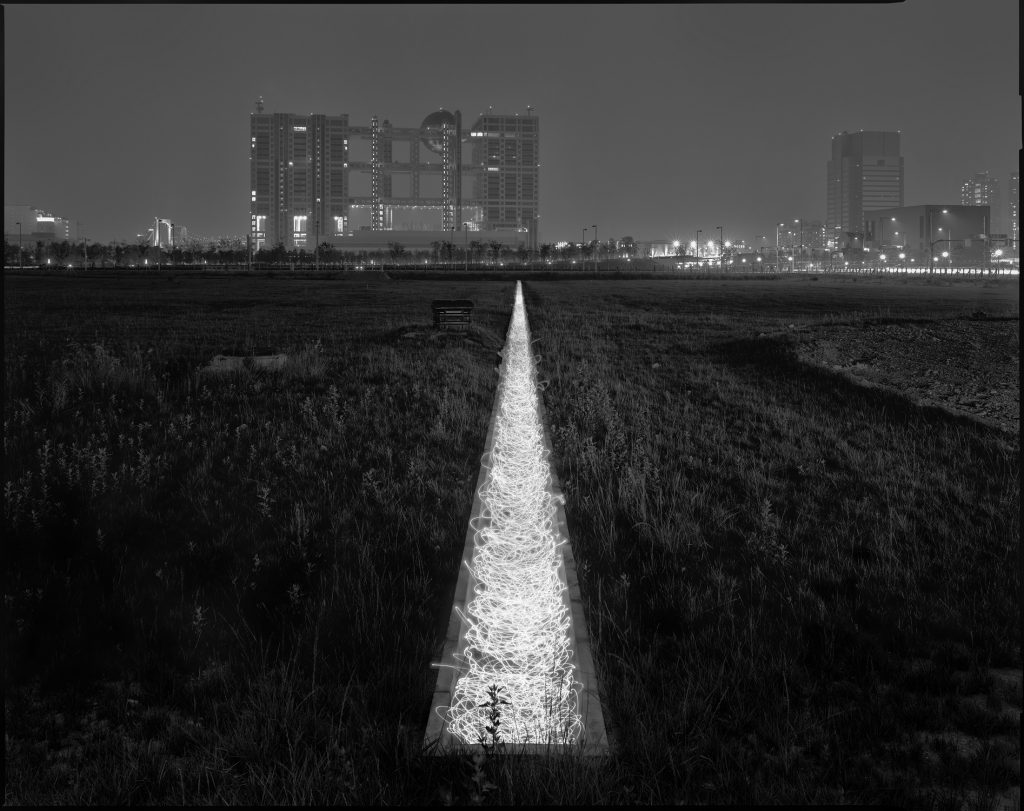
The process behind this image is as vital as the final print. Setting his view camera to a long exposure, Sato physically walks the length of the ditch whilst waving a light pen. The camera records only the continuous trace of this light source; his moving body is rendered completely immaterial. What remains is a pure distillation of his experience of movement within the space. The concrete walls define the boundaries of existence—stillness framing movement—whilst the illuminated lines trace his personal duration, juxtaposing the experiential over the rational.
Through this gesture, which echoes the harmonious and skilful choreography of Japanese calligraphy, Sato materialises time. We can understand in visual terms what Bergson theorised: stillness is inherently spatial, whilst movement and experience are temporal. We are no longer looking at a split-second snapshot of a landscape, but rather at a sculptural object made of time itself. Perhaps this is explained best by Sato himself, here an extract from our conversation:
“My interest is how to move in space. I have a rough idea of the resulting image before I begin, but I never make any plans or sketches. I am interested in affordance of the place/space. I enjoy moving under the influence of spatial quality. I enjoy even more being right inside a photograph in progress; photographic space in between 3-dimention to 2-dimentional space, imagining how my movements emerge on to 2-d. For example, being inside a 2-dimentional perspective space makes the meaning of one-metre length at the foreground very different from same one-metre at the background.”
Furthermore, Sato’s action invites us to consider the meditative practice of sabishi—an impersonal contemplation where one strives to express the true nature of an object whilst denying the self. Sato points out that his Photo-Respiration series relies on monotonous physical activities, where his focus is solely on breathing. Before he even begins his walk, he imagines the two-dimensional photographic space and projects his actions into the future, slowly and patiently filling the frame with lived experience.
In #278 Koto-Ku Aomi, the photograph becomes a paradox. It is an image of the past, yet constructed by an imagined future. By treating photography as a time exposure rather than an instantaneous capture, Sato allows us to apprehend time as a tangible surface. He extends the boundaries of sculpture, fixing the essence of duration onto photographic paper and urging us to see the landscape not just as a physical place, but as a living, breathing span of time.
04.08.2026
- “The Japanese sense of time, however, is different from the Western sense. We westerners think of time as linear and forward moving. In the ancient Japanese concept of ma, however, space and time are intimately linked in such a manner that time defines space and space defines time. Time is applied in Japanese art in a fundamentally different way: the art object often captures or embodies time, in addition to reflecting upon it or documenting it.” Sterns, Robert (Curator), Uchida, Yoko, associate curator, Komori, Yasuko, (coordinator) Photography and Beyond in Japan: Space, Time and Memory, Harry N. Abrams, Inc., Publishers, New York, 1997, p.70
↩︎