One Thing Next to Another: Helen Sear at HAPAX Living room
The traditional “white cube” gallery often demands a certain hushed reverence, a distance between the viewer and the work that can feel both clinical and static. However, stepping into the HAPAX Living Room for a residency session with Helen Sear RA, I was immediately struck by a different energy. This is a domestic space—a laboratory for experimentation where the curatorial process is stripped of its formal armour and returned to its roots: friendship, dialogue, and peers meeting across a table.
I was lucky to spend a full day here as part of HAPAX’s ‘curator for the day’, working alongside Helen as she sequenced images for an upcoming publication. In this setting, the act of curating felt less like a formal exercise and more like a shared investigation into what it means to look at nature through a fragmented, material lens.
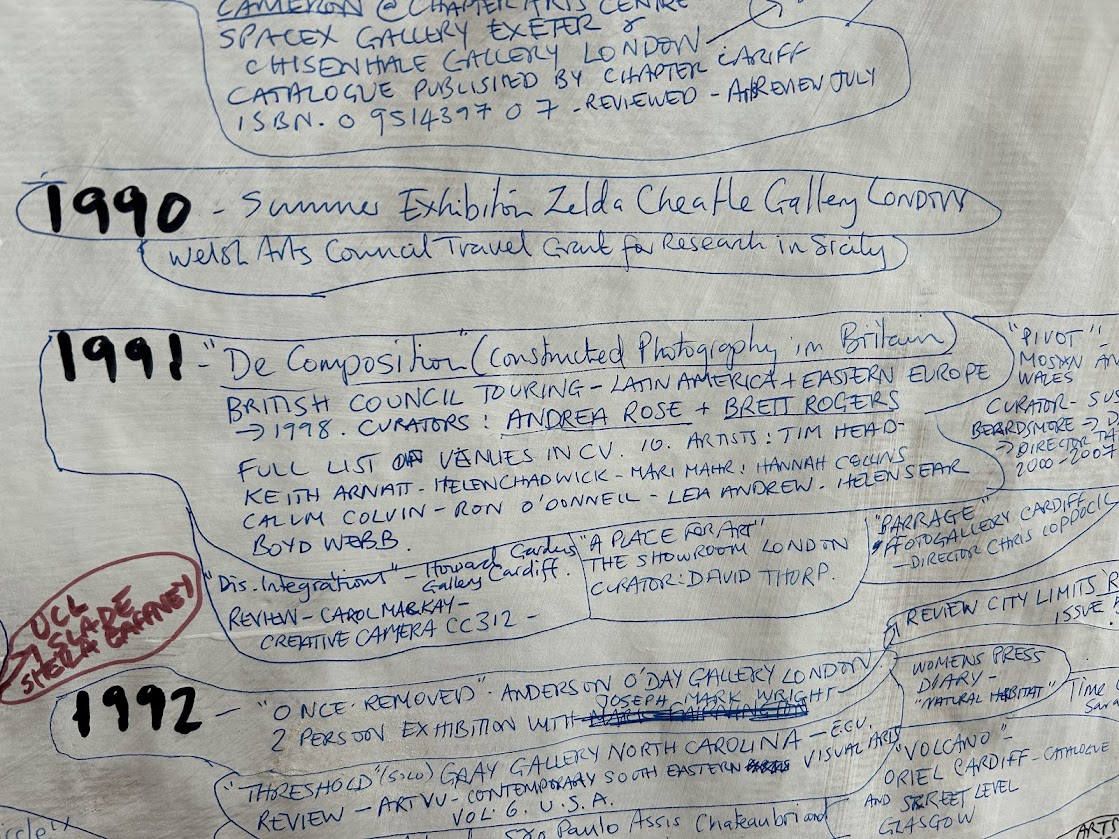
Aside from the rows of working prints on the wall, the first thing I noticed as I walked into the space was an annotated timeline—a map of Helen’s practice and I noticed and entry for the 1991 British Council exhibition, De-Composition: Constructed Photography in Britain. This milestone show, which featured Helen alongside artisits like Hannah Collins and Keith Arnatt, signalled a radical shift toward the ‘expanded field’ of the medium. It marked a moment where photography began to be understood not just as an image, but as a “constructed” material event. It is this specific lineage—the photograph as a material object—that Helen continues to interrogate today, treating the image not as a window, but as a physical layer of experience.
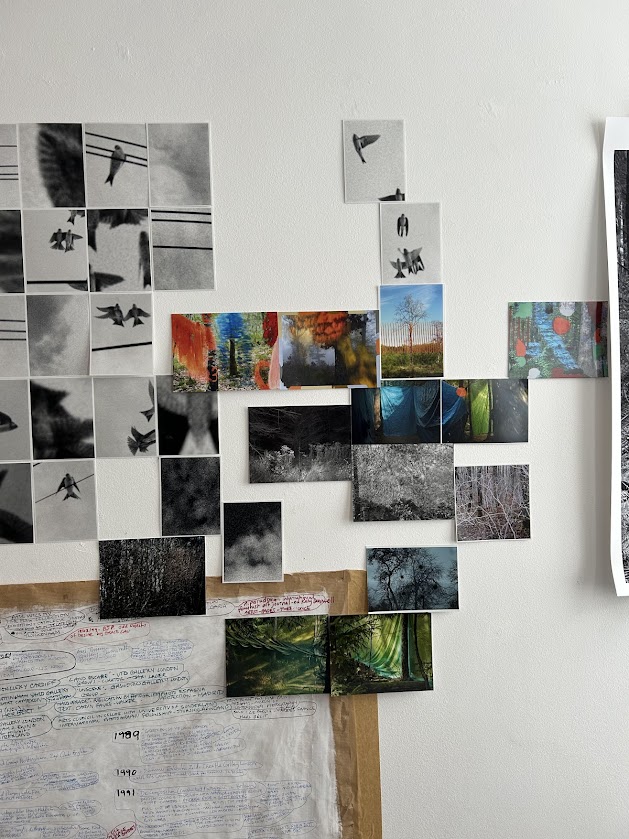
Our task was to navigate three distinct “islands” of work that Helen had laid out, each representing a different facet and moment of her practice. There were the birds — a deconstruction of a single photographic image where a flock on a wire became a series of graphic, rhythmic notations. Nearby, the Forest Experiments from her North Yorkshire residency Prospect-Refuge-Hazard (2019) captured some eerie occurrences: spray-painted symbols and “rural graffiti” that disrupted the dense, dark woods. On the opposite wall two works from her series Spirits of a Painted Forest (2020), where the digital image is released from the “thinness” of the paper and turned into material areas of paint, blurring the boundary between the photographic and the painterly. I was invited to move the working prints around, as we talked with Helen about the different projects. Her insights and anecdotes promptied new connections, resonances and overlaps.
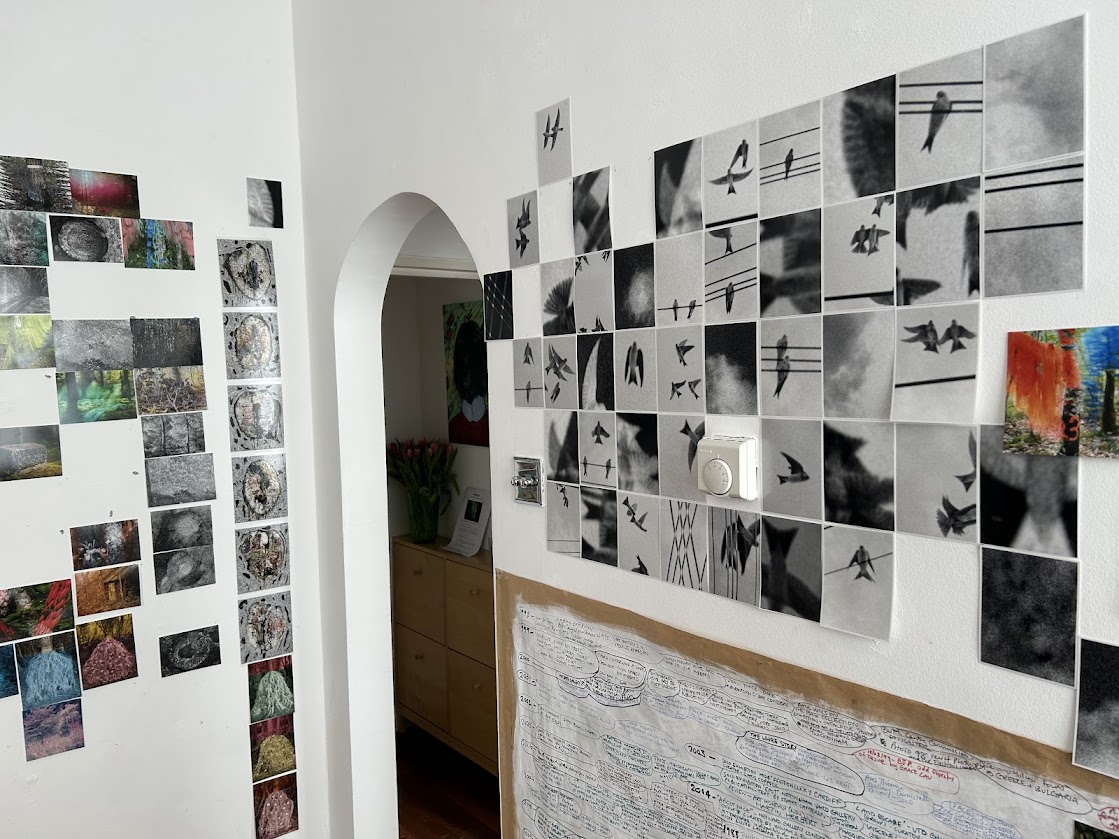
As I stood before these clusters, I began to see the constants between them—a language of natural and human interventions, evidenced by their marks in the landscape and the forest. Rather than allowing these series to exist in isolation, my response as a curator was to break the grid. I began to physically overlap the working prints, and by interlacing the graphic linearity of the birds with the mysterious, painted marks in the forest, we created a fluid, non-linear narrative.
The act of overlapping opens a sculptural dimension for the printed photograph and its relation to space; these images cease to be individual windows and instead become a single, continuous photographic object which extends to the gaps between them and into the architecture of the room.
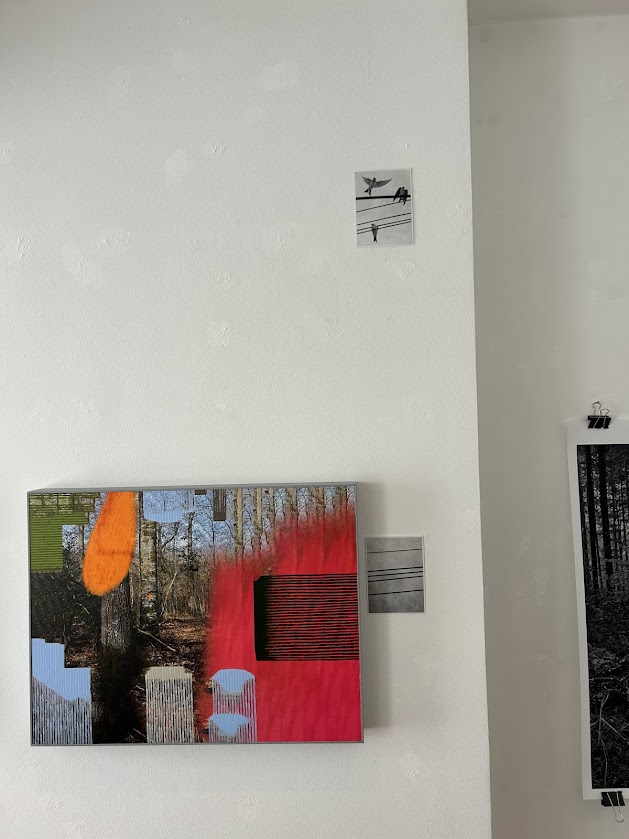
This method of questioning how we understand the landscape, especially these often difficult-to-describe forests—is a thread that connects Helen’s work to other artists I have collaborated with, such as Aliki Braine and Clare Hewitt. Whether it is Aliki’s physical ‘punch-outs’ or Clare’s patient observation of oak trees, they all share the same desire to look past the picturesque. In the HAPAX Living Room, Helen’s forest was temporarily released from the constraints of the frame and became a site for creative experimentation.
That’s why spaces like HAPAX Livng room are essential. They provide the stillness required to remember that an exhibition is not just a display of images, but a way to build new layered narratives in space. By breaking the grid and overlapping images across the walls of the room we started a collaborative dialogue in space. One to open new possibilities for a tactile, three-dimensional future of expanded photography.
10.04.26